Future of Jobs in the AI Era: Beyond Automation and Into Collaboration
As we navigate through May 2026, the future of jobs in the AI era is no longer a distant prophecy—it is our current reality. Artificial Intelligence is fundamentally reshaping labor markets by boosting productivity while simultaneously displacing traditional roles. While approximately one in five U.S. jobs faces a high risk of automation, the focus is shifting toward “human x machine” synergy. Undoubtedly, the workers who adapt to this new digital labor force will find themselves at a significant advantage.
1. Roles at High Risk of Automation
The most immediate impact of AI is felt in roles that involve repetitive, data-heavy, or predictable tasks. In 2026, several entry-level “stepping-stone” jobs are disappearing as companies prioritize cost efficiency.
- Customer Service & Receptionists: Basic support and front-line interactions are now largely handled by AI that can listen, understand, and respond with high accuracy.
- Data Entry & Bookkeeping: Automated data pipelines and AI-powered accounting systems have reduced the need for manual input and traditional bookkeeping.
- Manufacturing & Warehouse Work: Estimates suggest AI could replace up to two million manufacturing workers by 2026 as robotics in factories expand.
2. The Rise of New AI-Centric Careers
While some jobs vanish, the future of jobs in the AI era is also creating entirely new categories of employment. Demand for AI-related roles is surging globally, particularly in South Asia where job postings have seen a massive increase.
- Human-AI Collaboration Specialists: Professionals who redesign workflows to ensure humans and AI agents work together effectively.
- AI Trainers & Ethicists: Experts needed to “teach” AI models and ensure they operate within ethical and responsible frameworks.
- Prompt Engineers: Now a critical skill in marketing and product strategy, these specialists fine-tune AI outputs for specific business needs.
3. The 56% AI Wage Premium
One of the clearest signals of this shift is the financial reward for AI expertise. Actually, workers with AI skills now earn an average wage premium of 56% over similar roles without those skills—a figure that has more than doubled since 2025. Furthermore, one in ten job postings globally now explicitly requires AI proficiency. This makes digital literacy and AI adaptability the most essential factors for employability in 2026.
4. Essential Skills for 2026
To stay ahead, professionals must move beyond basic usage and master technical and conceptual AI skills.
- Python & SQL: These remain the foundation for machine learning, data science, and automation tasks.
- Data Literacy: The ability to clean, handle, and interpret the massive datasets that fuel AI systems.
- Critical Thinking: Since AI can handle the “how,” humans must focus on the “why,” formulating hypotheses and making decisions under uncertainty.
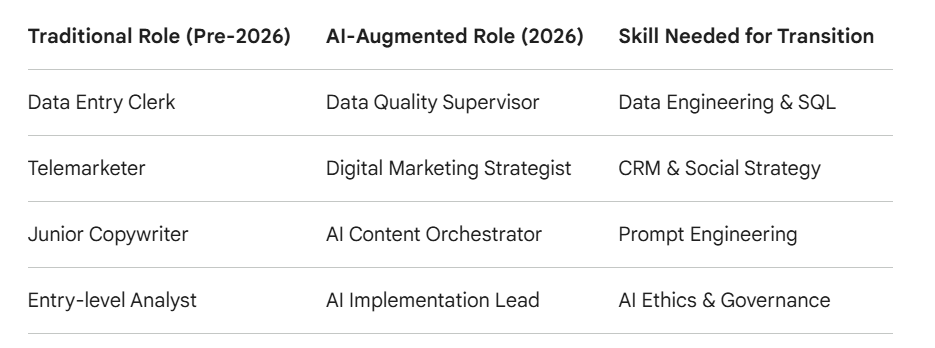
The Great Job Shift: Traditional vs. AI-Augmented Roles
Conclusion
The future of jobs in the AI era is not about a total replacement of humans but a total reorganization of work. Certainly, entry-level workers face the highest pressure to upskill quickly. Ultimately, the most successful professionals will be those who view AI as a collaborator rather than a competitor. Finally, for professional career roadmaps and the latest tech trends, stay connected with us at awanphotostat.pk.