Autonomous Personal AI Systems 2026: Beyond Traditional Operating Systems
Autonomous Personal AI Systems 2026: The Future of Productivity
Autonomous Personal AI Systems 2026 are currently marking the end of the “App Era” and the beginning of the “Agentic Era.” In May 2026, we are seeing a massive shift where artificial intelligence is no longer an app you open, but a core layer of the operating system itself. These systems can now manage your emails, schedule complex travel itineraries, and even handle financial transactions autonomously. Certainly, 2026 is the year where your devices finally start working for you, instead of you working on your devices.
The Shift from Interfaces to Intent
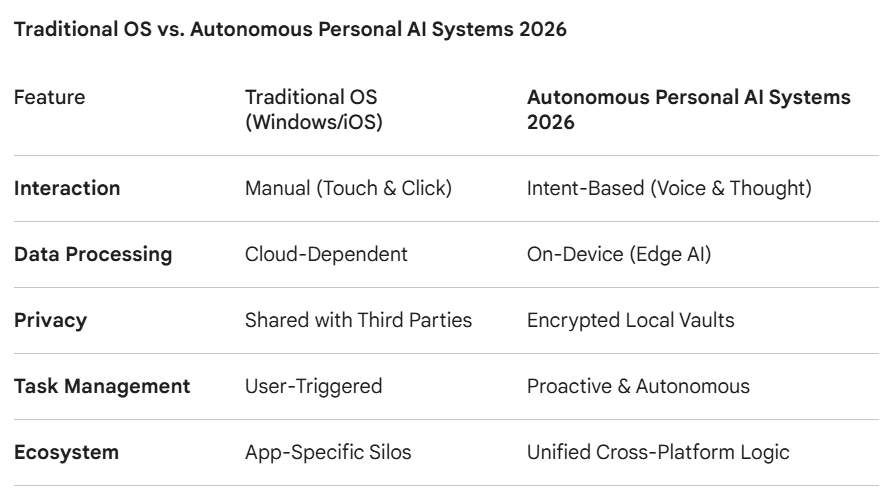
In the ecosystem of Autonomous Personal AI Systems 2026, the “User Interface” is becoming invisible. First and foremost, users are interacting with their devices through natural intent rather than clicking icons. Furthermore, with the latest M5-chip integration in wearables, these agents can predict your needs based on your biometric data and previous habits. Consequently, the traditional way of managing tasks is being replaced by a proactive, self-managing digital environment.
1. Local Processing and the “Privacy First” Mandate
One major breakthrough in Autonomous Personal AI Systems 2026 is the move toward “Edge AI.” First of all, to comply with the strict transparency laws of 2026, most AI processing now happens directly on your device rather than in the cloud. Moreover, this ensures that your most personal data—like private conversations or health metrics—never leaves your local hardware. In addition, this local processing has reduced latency to near-zero, making the AI feel like a real-time extension of your own mind.
2. Integrated Digital Twins
In May 2026, we are witnessing the rise of the “Digital Twin” within Autonomous Personal AI Systems 2026. First of all, these systems create a secure, virtual model of your preferences and professional expertise. Furthermore, your Digital Twin can attend low-priority meetings, draft reports in your unique writing style, and even negotiate basic service contracts while you sleep. Certainly, this level of delegation is freeing up humans to focus on high-level creativity and strategic decision-making.
3. The Impact on Work-Life Balance
The real-world impact of these systems is already visible in the global labor market. First of all, the 4-day work week is becoming a reality for many tech companies because AI agents are handling the administrative “busy work.” In addition, the integration of AI with smart home hardware means your environment now adjusts itself—lighting, temperature, and even meal prep—based on your stress levels and schedule. Therefore, 2026 is not just about faster tech; it’s about a more balanced lifestyle.
Conclusion
Staying ahead of the trends in Autonomous Personal AI Systems 2026 is essential for anyone looking to master the next wave of digital evolution. Therefore, stop thinking of AI as a tool and start viewing it as a dedicated partner in your daily life. Certainly, the barrier between human intent and digital execution has finally vanished, opening up a world of limitless potential.
Which part of your daily routine would you delegate to an autonomous agent first? Let us know in the comments!