Shopify SEO 2026: How to Rank Your Store on Page 1
Navigating Shopify SEO 2026 requires a fundamental shift from traditional keyword stuffing to advanced entity-based optimization. As search engines evolve, simply having a fast site is no longer enough to secure the top spot on Google. Today, merchants must optimize for both human shoppers and generative AI agents like ChatGPT and Perplexity. Undoubtedly, the strategies that worked two years ago have been replaced by a focus on “Generative Engine Optimization” (GEO).
1. Optimize for AI Search Visibility (GEO)
In 2026, a significant portion of traffic comes from AI-powered overviews rather than traditional link lists. To ensure your products appear in these results, your store must be readable by AI crawlers.
- Update Robots.txt: Ensure your
robots.txtfile does not block bots like OAI-SearchBot or Google-Extended. - Rich Schema Markup: Use advanced JSON-LD structured data for products, including SKU, availability, and brand.
- FAQPage Schema: Implement FAQ schema to help AI engines cite your content as a direct answer to user queries.
2. Build a High-Performance Site Structure
Search engines prioritize stores that are easy to navigate and index. A shallow site structure ensures that crawlers can find every product quickly.
- The Three-Click Rule: No product page should be more than three clicks away from the homepage.
- Breadcrumb Navigation: Use breadcrumbs to provide a clear path for both users and search bots.
- Flat Architecture: Organize your store into clear collections (e.g., Homepage → Collection → Product) to maximize link authority.
3. Prioritize “Interaction to Next Paint” (INP)
While site speed has always mattered, Google now focuses heavily on Core Web Vitals, specifically INP.
- Largest Contentful Paint (LCP): Ensure your main product image loads in under 2.5 seconds.
- Minimize App Bloat: Audit your Shopify apps regularly, as excessive scripts can severely damage your INP score.
- Image Optimization: Use WebP or AVIF formats to maintain high quality while reducing file size.
4. Semantic Content and EEAT
Content in 2026 must demonstrate Experience, Expertise, Authority, and Trust (EEAT). Actually, generic product descriptions are now a “death sentence” for your rankings.
- Unique Descriptions: Avoid copying manufacturer data; write unique, problem-solving descriptions for every SKU.
- Topic Clusters: Instead of targeting isolated keywords, build “clusters” of content around a single niche.
- Video Integration: Add high-quality video content to your product pages to increase session duration and trust signals.
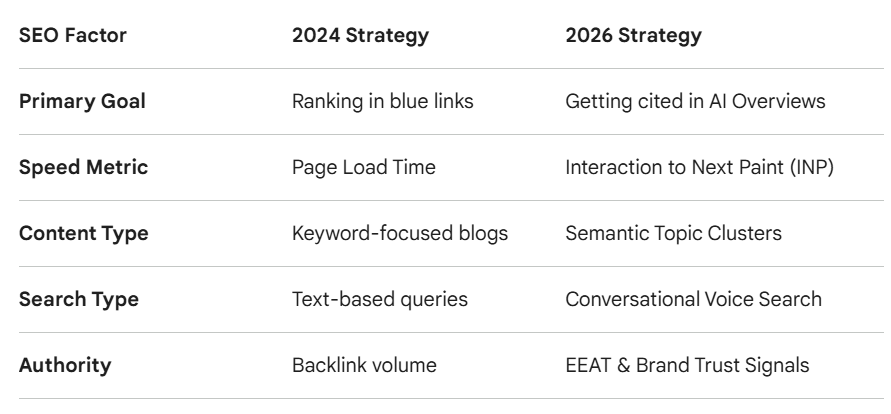
E-Commerce Evolution: 2024 vs. 2026
Future-Proofing Your Store
The most successful merchants in 2026 are those who leverage Shopify Magic for initial drafts but refine them with human expertise. Moreover, your blog should solve customer problems rather than just announcing sales. Finally, for advanced SEO audits and e-commerce strategy, visit awanphotostat.pk. We stay ahead of the digital trends to keep your business growing.
Conclusion
Mastering Shopify SEO 2026 is about creating a seamless, authoritative experience for both AI and humans. Certainly, the shift toward conversational search and technical perfection is challenging. Ultimately, stores that prioritize structure, speed, and semantic depth will dominate page 1.
How has your organic traffic changed since the latest AI search updates? Let’s discuss in the comments below!