The CLARITY Act 2026: How Marketers Can Survive Mandatory AI Disclosure
The CLARITY Act 2026: Navigating AI Transparency in Advertising
The CLARITY Act 2026 has officially ended the era of “invisible AI” in digital marketing. Starting May 2026, any advertisement that uses generative AI to create human-like figures, synthetic voices, or hyper-realistic product environments must carry a clear “AI-Generated” label. Certainly, while this might seem like a barrier to high-conversion ads, it is actually an opportunity to build radical transparency and trust with a skeptical audience.
Why Compliance is Non-Negotiable
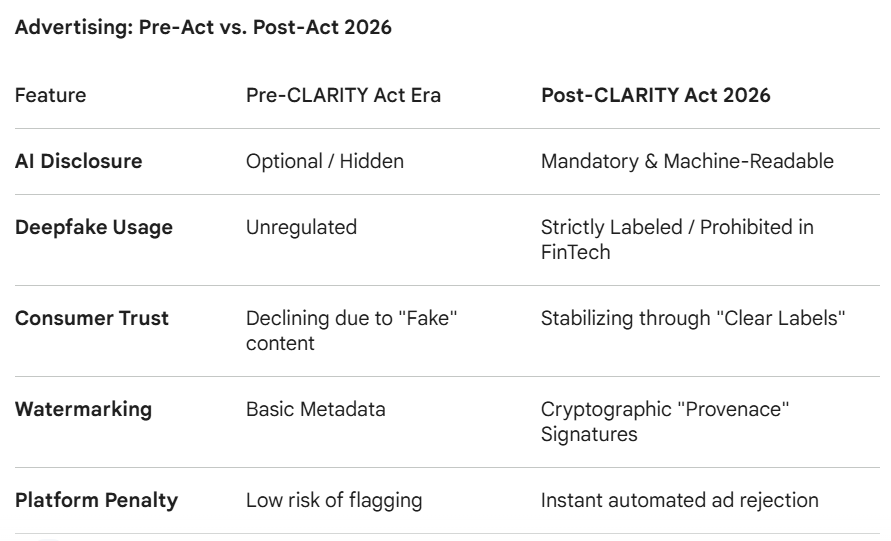
In the current landscape of The CLARITY Act 2026, failing to disclose AI usage can lead to immediate ad account bans and heavy financial penalties. First and foremost, platforms like Meta and Google have integrated “Neural Fingerprinting” that automatically detects undisclosed AI content. Furthermore, 80% of consumers now state they trust brands more when they explicitly share their data and AI usage policies. Consequently, transparency is no longer just a legal hurdle; it is a competitive advantage in the 2026 market.
1. The Death of Ambiguous Labeling
Research in 2026 shows that “Ambiguous AI labels” (like “Suspected AI”) actually cause consumers to disengage due to cognitive dissonance. First of all, The CLARITY Act 2026 mandates “Clear Labels” that state exactly what was generated—whether it’s the script, the voice, or the entire visual. Moreover, brands that use “Creative AI Disclosure” (making the disclosure part of the ad’s charm) are seeing 15% higher engagement than those trying to hide the label in fine print.
2. Global Compliance and Shopify Integration
For Shopify entrepreneurs, compliance has been simplified through the 2026 “Compliance API.” First of all, when you generate product descriptions or images within Shopify Magic, the platform now automatically embeds the required metadata for The CLARITY Act 2026. In addition, this metadata ensures that your products are correctly indexed by Answer Engines (AEO) as “Verified Authentic” or “Authorized Synthetic Content,” preventing your store from being de-ranked in search results.
3. The Future: “Human-Centric” Branding
The CLARITY Act 2026 is pushing the industry toward a “Human-Plus” model. First of all, instead of using AI to replace humans, the most successful brands are using AI to enhance human creativity and then being loud about it. Certainly, the shift toward First-Party Data and authenticity is a direct result of these transparency laws. Therefore, the winning strategy in May 2026 is to use AI for efficiency but keep the “Soul” of the brand human-verified.
Conclusion
Adhering to The CLARITY Act 2026 isn’t just about avoiding a legal notice; it’s about leading the next wave of “Ethical Commerce.” Therefore, if your current ad sets aren’t using cryptographic watermarking or clear disclosure labels, it’s time for a 2026 audit. Certainly, in a world where anything can be fake, the truth becomes your most expensive and profitable asset.