Circular E-commerce 2026: The Profitability of the Resale Revolution
Circular E-commerce 2026: The Profitability of the Resale Revolution
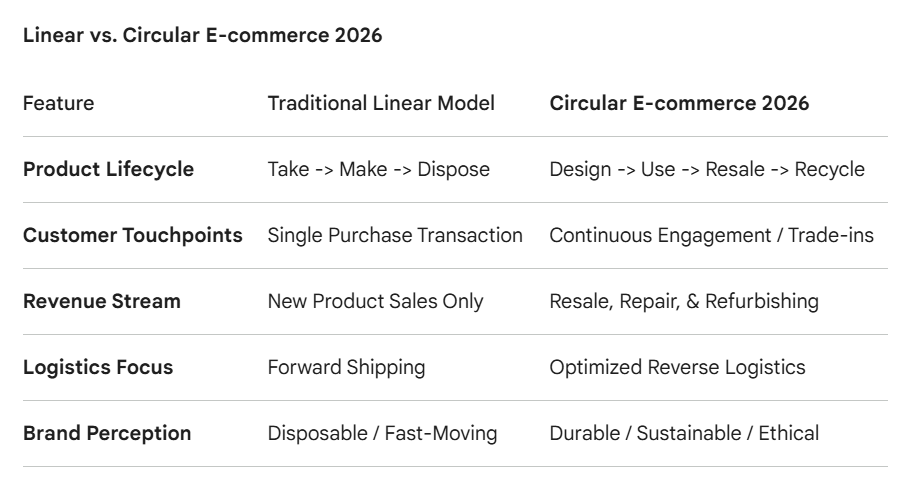
Circular E-commerce 2026 is redefining the global retail landscape as consumers move away from “fast fashion” and toward long-term product value. In May 2026, the second-hand market is growing 11 times faster than traditional retail, driven by Gen Z’s preference for sustainability and the rising cost of raw materials. For brands, this shift means moving beyond the “sell-once” model to a circular journey where products are repaired, resold, or recycled. Certainly, 2026 is the year where “pre-loved” becomes a premium category.
The Financial Logic of Re-commerce
In the current ecosystem of Circular E-commerce 2026, profitability is found in the “LTV” (Life-Time Value) of a physical product. First and foremost, brands that own their resale channel retain 100% of the customer data and secondary sales revenue. Furthermore, circular models reduce the need for constant new inventory, protecting brands from global supply chain shocks. Consequently, businesses adopting these models are seeing a 25% increase in customer retention rates compared to linear competitors.
1. AI-Driven Reverse Logistics and Authentication
The biggest hurdle to Circular E-commerce 2026 has always been the complexity of returns and reselling. First of all, AI-powered inspection tools now allow brands to instantly verify the condition and authenticity of returned items via a smartphone scan. Moreover, automated “Repair-to-Resale” workflows on platforms like Shopify help merchants refurbish items and relist them in minutes. In addition, the rise of specialized logistics providers means that collecting and processing used goods is now as cheap as shipping new ones.
2. “Resale-as-a-Service” (RaaS) for Shopify Brands
For entrepreneurs, the barrier to entry has disappeared. First of all, Shopify’s 2026 “Circular Suite” allows store owners to add a “Sell Back” button to their customers’ order history with one click. Furthermore, brands can now offer “Circular Credits” or store vouchers in exchange for used goods, ensuring that the capital stays within their own ecosystem. Certainly, this “Resale-as-a-Service” model is turning every customer into a potential supplier for the brand.
3. The Shift in Consumer Identity
In 2026, owning a “circular” product is a status symbol. First of all, blockchain-backed “Digital Product Passports” now allow customers to see the entire history of an item, including its previous owners and carbon footprint. In addition, marketing strategies are shifting toward “Storytelling Through Repair,” where the wear-and-tear of a product adds to its emotional and financial value. Consequently, the most successful brands of 2026 are those that celebrate the longevity of their creations.
Conclusion
Adopting Circular E-commerce 2026 strategies is the most effective way to future-proof your brand against both economic volatility and changing consumer values. Therefore, if you aren’t thinking about how to buy back your own products, you are leaving a massive secondary market to your competitors. Certainly, the future of shopping isn’t just about what’s “new”—it’s about what’s “next” for everything we already own.
Are you planning to launch a resale or trade-in program for your store this year? Let us know in the comments!